Writing as a Ritual of Creation and Destruction
The Dark HalfWriting as a Ritual of Creation and Destruction is the process through which Thad Beaumont confronts the double he once brought into being as George Stark. In the hostage crisis, writing is at once a practical instrument, a contest over authorship, and a ritualized transfer of power. Its outcome remains uncertain, but its central premise is explicit: the words that made Stark may also be the only means of removing him.
The written word as cause and remedy
Thad tells Liz that no trick or special effect is involved: words on paper made Stark, and words on paper are the only things that can get rid of him. The statement turns writing from a metaphor for creation into a rule governing the conflict. Stark’s existence is tied to the page, so the page becomes the place where Thad must try to alter the danger he has helped unleash.
Yet Thad does not treat this rule as a guaranteed solution. He doubts that Stark knows whether the process will work, and judges that Stark is acting on hope. The uncertainty matters: writing offers a possible way out, not a proven method, and the characters must proceed without knowing what their words will do.
A ritual of exchange
As the two men prepare to write, Thad understands that they are not simply composing a story. He describes the encounter to himself as a transfer of power, like passing a baton, and as a trade in which Liz’s and the twins’ lives are at stake. What Stark is receiving in return remains unclear to Thad. The blankness of that exchange is part of its danger: the writing has consequences, but neither its price nor its final result can yet be named.
Thad also senses that Stark may be trying to look into his thoughts. He resists that intrusion, contrasting Stark’s apparent advantage with the “bunch of scraggy birds” available to him. The image establishes the unequal terms of the contest while identifying the sparrows as Thad’s counterforce. Writing is therefore not a solitary act of control; it takes place within a struggle over what each man can know and command.
The book changes hands
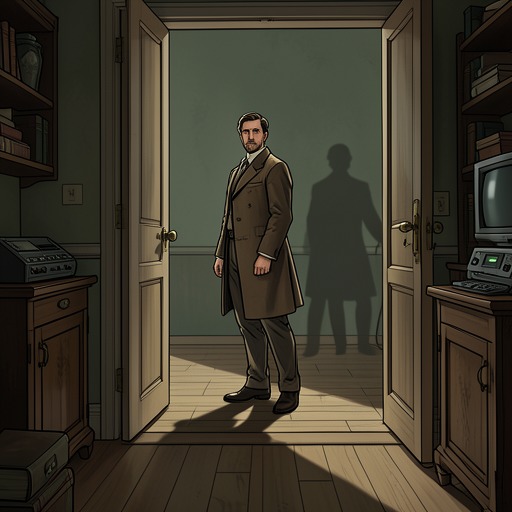
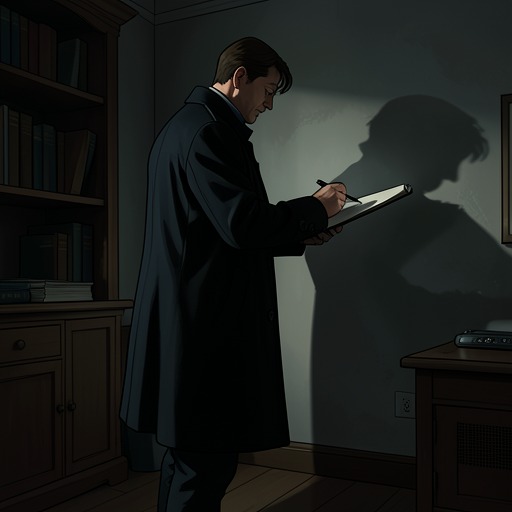
When Liz leaves the two men alone, Thad opens his notebook and studies its blank page before taking a sharpened Berol pencil. The pause makes the page a threshold: the act is deliberate, and the writing has not yet begun. The concrete tools—a notebook and pencil—also anchor the supernatural contest in a familiar author’s work.
Thad finds that his own desire to continue the book has weakened since Liz and Alan left the study. He understands this change as a separation, an “obscene birth,” and recognizes that the book is no longer his. Alexis Machine, its central figure, belongs with the person who, in Thad’s judgment, owned him from the beginning: Stark. The shift in ownership recasts the writing session as a transfer rather than a collaboration freely chosen. The novel that once expressed Thad’s authorship has become bound to the identity he is trying to resist.
The final written appeal
On the blank sheet, Thad writes “PSYCHOPOMPS” in capital letters, circles the word, and draws an arrow beneath it. He then writes “THE SPARROWS ARE FLYING.” The arrangement gives the page the form of a compact sign or instruction: first the name for guides of the dead, then the declaration that the sparrows are in motion. Instead of continuing the novel, Thad turns to the beings he associates with the struggle against Stark.
This ending brings the ritual’s two directions together. Writing first gave Stark a path into reality; now Thad uses written words to call upon a force that may help end his presence. The text does not establish that the final notation succeeds, so the page remains both an appeal and an uncertain wager. Its decisive significance lies in the reversal it stages: the author who once created a character through writing now uses writing to challenge that creation.